
Subscribe to continue reading
Subscribe to get access to the rest of this post and other subscriber-only content.
Making revelations and family connections. Genealogy, Family History, African American Family History
Subscribe to get access to the rest of this post and other subscriber-only content.
Subscribe to get access to the rest of this post and other subscriber-only content.
As I dig for my roots, I add another relative to my family tree: my second great-aunt, Malinda Method.
I gathered several documents, including her marriage registry, census records, death announcements, and death certificate, to develop a brief sketch of her life.
Malinda is the second-oldest of Solomon’s children. Recently, I learned about her passing in my hometown. The earliest document I have is her marriage registration in 1876. Matilda Methodist, 22 years old from Virginia, married James W. Galloway, 24 years old from Maryland, in Piedmont, West Virginia. The registry says her parents are unknown.
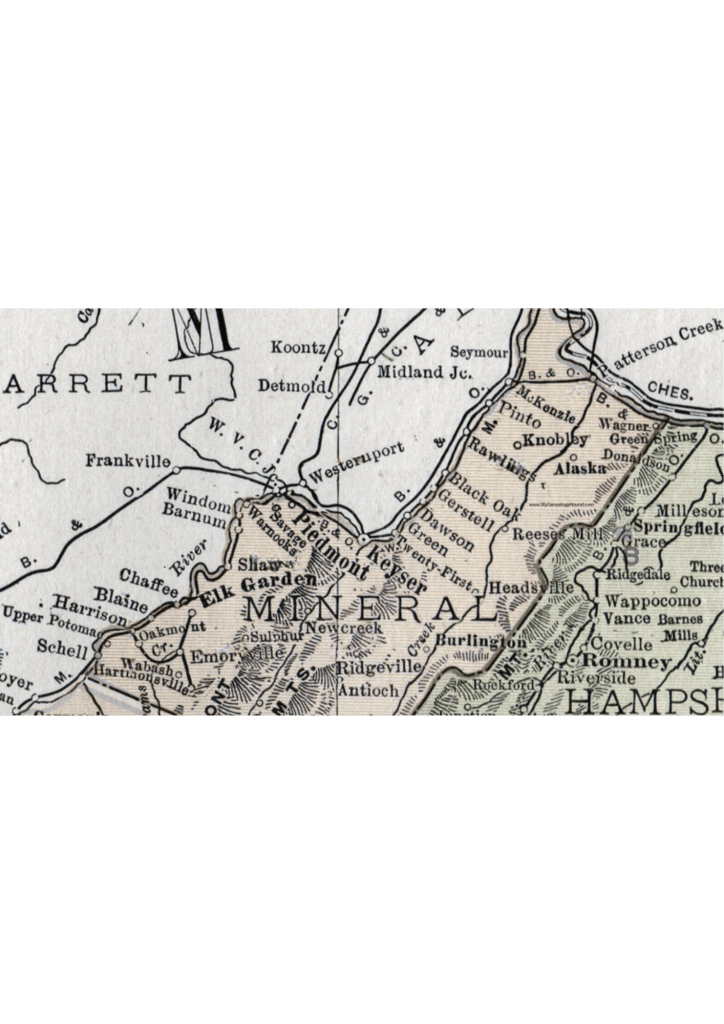
How do I know that this bride is my aunt if her parents are unknown and her last name is different?
According to Matilda/Malinda’s age at the time of the marriage registration, her birth year is 1854. West Virginia was not a state during this time. Emancipation liberated enslaved people in 1863, and West Virginia abolished slavery in 1865. Unfortunately, she was born in bondage. It is not unusual for formerly enslaved people to forget their parents’ names if they experienced separation.
Solomon married his wife, Mildred, in 1869. Antebellum laws prohibited enslaved people from legal marriages. Newly freed people experienced financial hardships, and a couple postponing to make a union legal is understandable due to registration fees.
Finally, the name Matilda may have been a clerical error by the registrar. All the supporting evidence recorded after her marriage indicates that her name is Malinda and that she is the daughter of Solomon Method.
The 1870 Federal census was the first to include African Americans counted by name, and Solomon’s family members are together except for Malinda in Moorefield, West Virginia.
| Solomon | 53 |
| Mildred | 52 |
| Amanda | 20 |
| Phebe | 16 |
| Charles Clinton | 12 |
| Mary Alice | 10 |
| Mary Jane | 6 |
Table 1: Abbreviated and Derived Table from the 1870 Federal Census.
James and Malinda Galloway thrived in Westernport, Maryland. Initially, he worked as a blacksmith. They owned their homes. Her husband retired as an engineer from the local Paper Mill located in Piedmont. The couple experienced child loss. Malinda became a widow in 1928 when James died two years after he retired. Therefore, Malinda lived alone. Most of her immediate family members had passed around this time as well.
| Method Family Vitals | |
| Mldred | 1818 – 1875 |
| Solomon | 1817 – 1881 |
| Amanda | 1850 – 1894 |
| Phebe | 1854 – 1930 |
| Charles Clinton | 1858 – 1933 |
| Mary Jane | 1860 – 1933 |
| Mary Alice | 1864 – 1900 |
Later in life, she regularly visited her grandnephew during the holidays in Columbus, Ohio.
Click the link to see how Malinda Galloway may have traveled to Columbus in 1941.
Charles Arthur Method was the grandson of Reverend Charles Clinton Method. In the 1920s, Charles Clinton became the assistant pastor of Mt. Vernon A.M.E., located in the historical Bronzeville community on Mt. Vernon Avenue in Columbus. Family members are still active in this church. Rev. Method’s son, Dr. William Arthur Method, co-founded the Alpha Hospital in the same area. Dr. Method died a few years after his father in 1936. William’s son, Charles Arthur, lived with his wife on the East side of Columbus, in Bronzeville. During Malinda’s visit in December of 1941, she passed on the 17th.
My grandmother migrated to Columbus in the later phase of the “Great American Migration” in the 1950s, following her older sisters, who relocated there in the 1940s. She became a member of Mt. Vernon A.M.E. I discovered our connection to the local historical figure, Dr. Method, years ago.
My cousins and I asked each other, Did they know about us?
Sources:
West Virginia Counties Marriage Registry
Federal Census records
Allegany County Voters’ Registration
Franklin County, Ohio Vital Records
Piedmont Herald Newspaper
Cumberland Times Newspaper
Learning how an African American person lived before emancipation can be challenging. Especially if you make a genealogical brick wall that keeps you at a standstill.
How do you make a genealogical brick wall you ask? By not exhausting all options and limiting your scope of search. I did just that with my ancestor, Thomas Jefferson Holly, who went by his middle name Jefferson. I found him in the 1870 census with his wife, Maria, and children: Andrew, Maggie, and Lucy in Westernport, Allegany County, Maryland. The record revealed that Jefferson and Maria were born in Virginia. Their surname was phonetically spelled H-a-w-l-e-y.
Due to their location at this time, I assumed they lived in the Western part of Virginia. Are you familiar with the expression around the word assume? I searched all of West Virginia’s county databases for Jefferson and Maria before their lives in Maryland. I spelled their names in various ways hoping for a hit, but no success.
The next area to look was all of Virginia. Finally, I found Thomas twice in the 1860 census with two different families, one Black and one White. On June 20th, the census taker entered him as Thomas J Holly with the Shelton family. William Shelton’s occupation was a Blacksmith. In the other entry dated August 15th, Jefferson Holly was counted with his mother, Grace, his six siblings, sister-in-law, niece, and nephew.
What’s so exciting about finding teenaged Thomas Jefferson Holly is that he was a free inhabitant of Rockingham County. He and his family were free people of color!
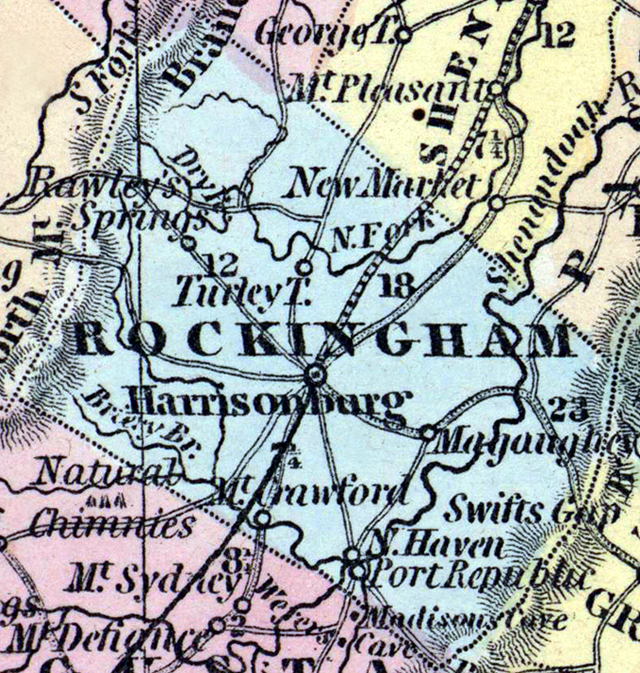
How do I know that this is the same person, my ancestor? I compared the age, and how frequently he used his middle name which is consistent with the later documents I undercovered for him. He developed his skill in Blacksmithing. It is how he supported his family in Maryland. Blacksmiths made more than horseshoes. They made and repaired tools, which is what he did for coal miners sharpening their picks in Western Maryland.
I recommend that you expand your research borders before for your African American ancestors. Go beyond the geographical area. Play with the spelling variations. Consider their occupations.
Have you been climbing a brick wall?
Want my help in breaking that wall down?
Reach out to me at Admin@diggin4myroots.com
Subscribe to get access to the rest of this post and other subscriber-only content.
The Maryland General Assembly passed a law in 1805 to keep a close reign on Free People of Color by issuing free negro certificates. A common term for these certificates is papers.
My Holly ancestors visited the Allegany Courthouse on May 11th,1833 to receive their papers. The certificate explains how they are free and gives a physical description of each family member.
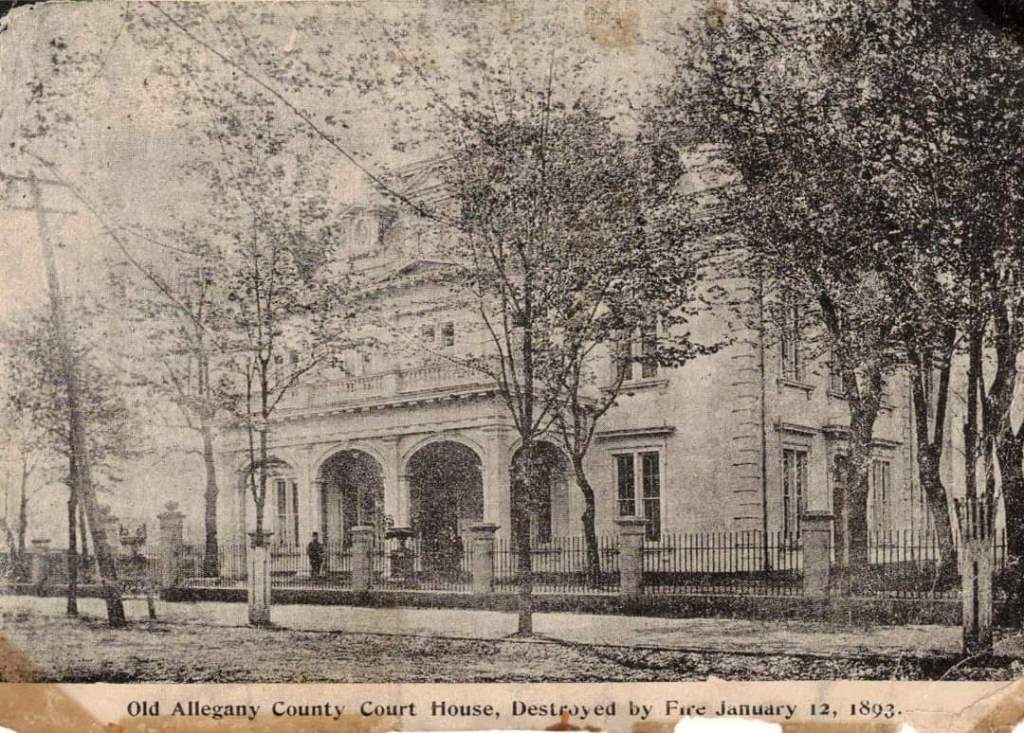
The Allegany County Book Q records their visit. The first person listed is Thomas Holly. I believe this is my fourth Great-grandfather. He is 17 years old, 5’1. He is described with a yellow complexion. Thomas has a brother, James, and three younger sisters, Sarah, Mary, and Carrelus. The notation regarding their free status indicates their parents are free and the siblings were born in Cumberland.
My paternal family has been living in the United States free(ish)ly for over two hundred years!
Subscribe to get access to the rest of this post and other subscriber-only content.
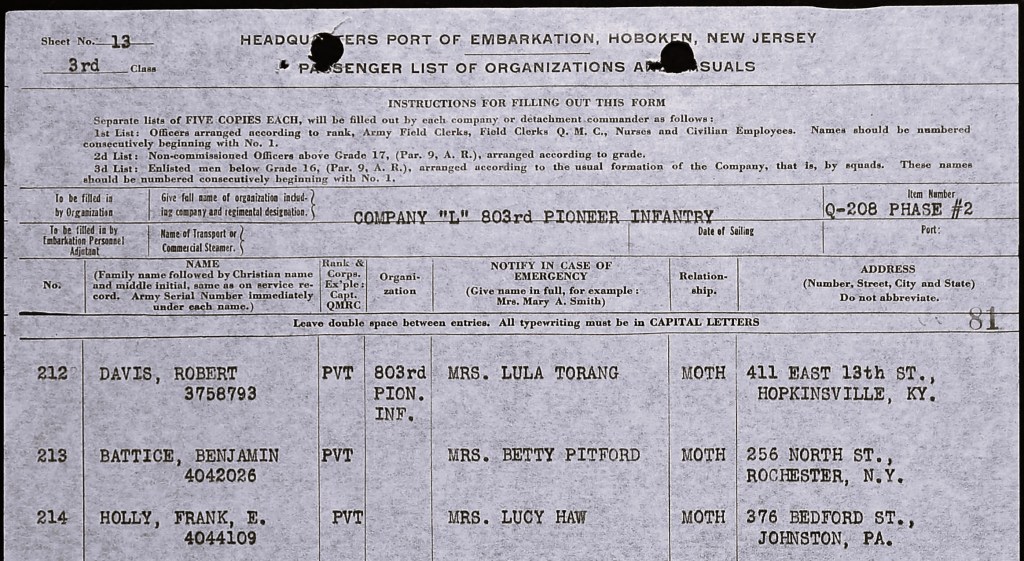
Frank Edward Holly was my paternal Great-grandfather, a World War I veteran. Allegany County is where he grew up with his older sister, Bessie, and, their mother, Lucy on the western side of Maryland that borders West Virginia.
Since it is Memorial Day weekend, I am sharing how I learned about my ancestor’s life through military records and events surrounding the draft. After the United States declared war on Germany, many American men did not volunteer to fight. The Selective Service Act was enacted that required men ages, 21 – 30, to register in the military on May 18, 1917, to meet the military’s need. Frank provided an 1889 birth year on his enlistment in Mineral County, West Virginia on June 5, 1917. He made the cut by two years.
Military records can reveal several pieces of genealogical information for a researcher: name, birthday, birth location, citizenship status, marital status, employer, residence, next of kin, and physical description.
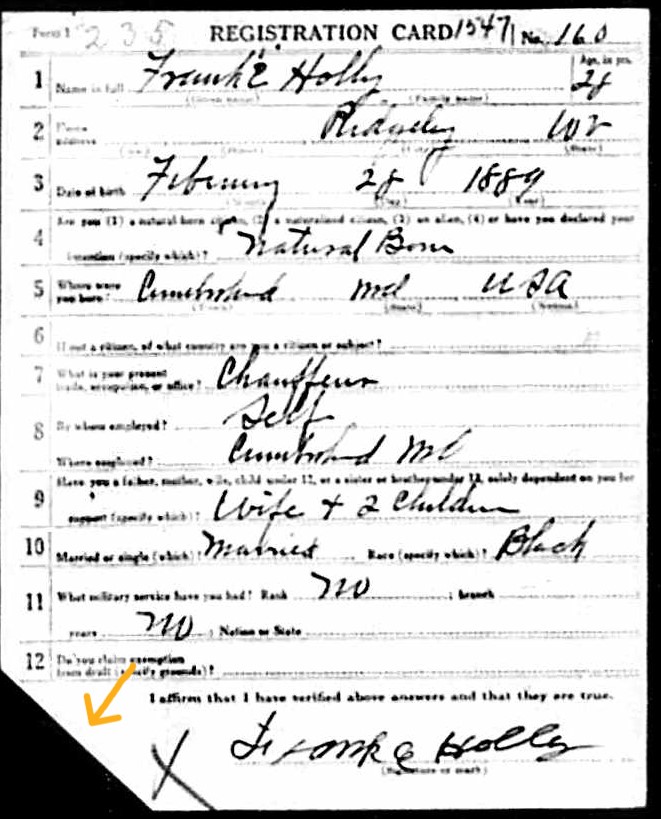
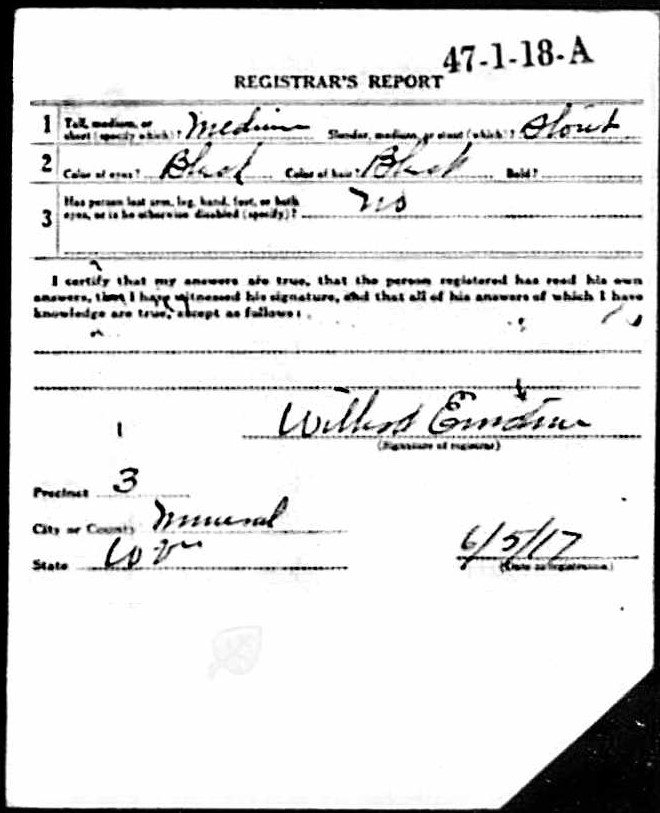

All men in that age range were required to enlist, however, there were a few exceptions. Selective Services had deferments and exemptions to the draft. These are two examples below.
Temporarily deferred, but available for military service.
Married registrants with a dependent spouse or dependent children under 16 with sufficient family income if drafted.
Exempted due to extreme hardship.
Married registrants with a dependent spouse or dependent children with insufficient family income if drafted.
A day before my Great-grandpa’s 28th birthday he applied for a divorce and custody of his children. Frank’s six-year marriage to Lillian Farley produced my two Grand Aunts, Carrie, and Lucille. I did not have the pleasure to meet them, however, their experience and knowledge about Frank Holly gave me a genealogy boost.
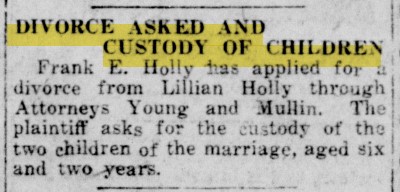
Frank began his military training in August. If his goal was not to participate he failed.
His attempts to gain custody and avoid the war were unsuccessful.

Early into my family research, I met my father’s first cousin, Lillian, and Frank’s grandson, Andy online through Ancestry’s site. We made an instant family connection. Our conversations went from email messages to telephone calls. Andy shared that when he was young his Grandmother Lillian drove him through W.VA and Western Maryland. She told him that this was where his grandpa’s family lived. Andy closed our conversation with instructions, “Look up, Lonaconing.”
I didn’t know if Lonaconing was a person, place, or thing. My first thought was glass manufacturing. I discovered a clipped newspaper article titled, “Remembering the Blacks of Lonaconing.” The reporter interviewed an elderly person in the community. She recalled the only Black people living in their town. Lonaconing is one of the five cities/towns in Allegany County. Andy and I were both excited about my discovery. The write-up mentioned Frank’s Grandpa, Thomas “Jefferson” Holly.
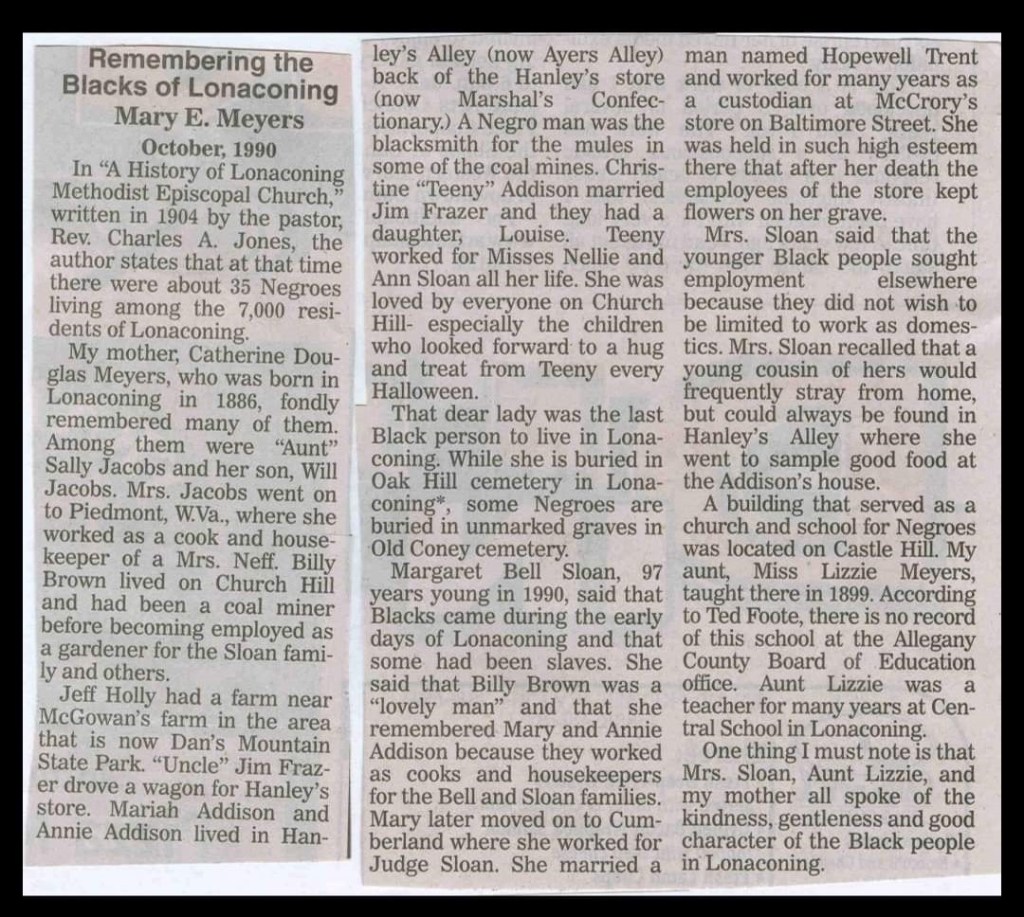
Andy remembered Aunt Carrie describing her father. “My dad was an Indian. He wore long braids and buckskin.” I connected with a second cousin on 23andme. Our grandfathers were brothers. Her dad shared the Lonaconing account with his dad. Her Grandpa said, “My dad lived in Lonaconing as a boy.”
I appreciate my Great-grandfather’s service. His military activities left records to trace his actions and learn some insight about him. During this holiday a few sites have free access to view their military record database. You may make a family connection while searching.
Please stay tuned and subscribe!
Sallie Francis Method was my paternal ancestor, born during the American Reconstruction Era to an unwed mother, Phoebe Method.1 Sallie was her mother’s fifth child and second daughter. Her grandparents, Solomon Method and Millie Davis Method lived in the town of Moorefield, Hardy County before the Civil War, before the area became a part of the new state called West Virginia.
In her late teens, Sallie worked for a wealthy farming family as their nanny. I learned about her job through the cemetery’s groundskeeper.2 He recalled how the former Moorefield Mayoress (mayor’s wife), Myrtle Miley Pickard visited him while he maintained the Oak Hill cemetery where Sallie is buried.3 He said Myrlte stood near her marker and said, “She was my nanny.”
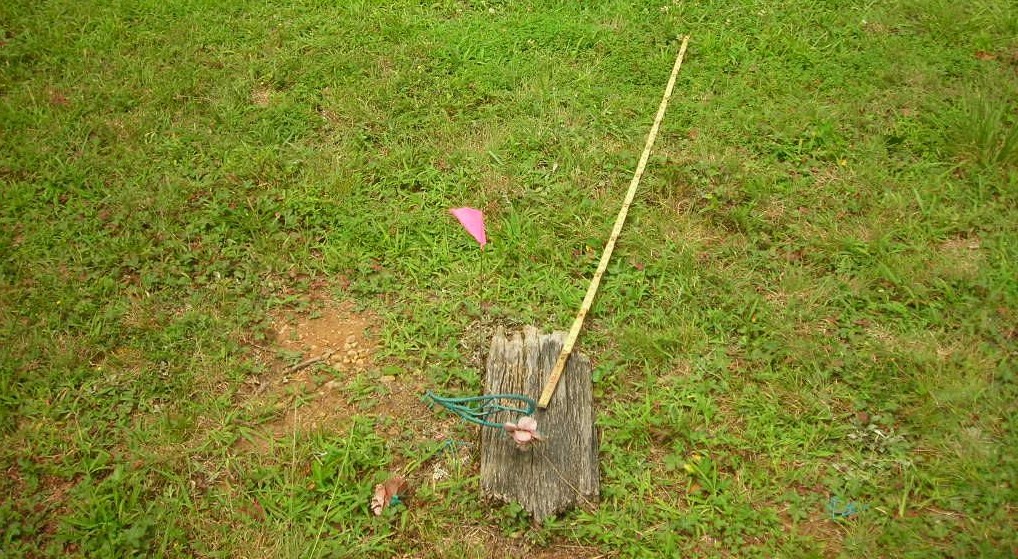
Sallie’s grave marker.
Photo Credit: Glon Turner, Find A Grave Volunteer. Mr. Turner gave me a lead to interview Mr. Washington for my research.
Prior to her passing, Sallie raised eight children mostly on her own. The mother of two, Charles and Edna, became Willard Ford’s third wife in 1914. 4 She and Willard would have three daughters Mary, Mildred, and Helen. Willard was killed in December 1918 while Sallie was pregnant with their youngest daughter.5 Sallie supported her family as a restaurant cook.6 She owned her home and grew her own food. Her daughter said, “We had fields and fields of land.”7 She birthed three more daughters.
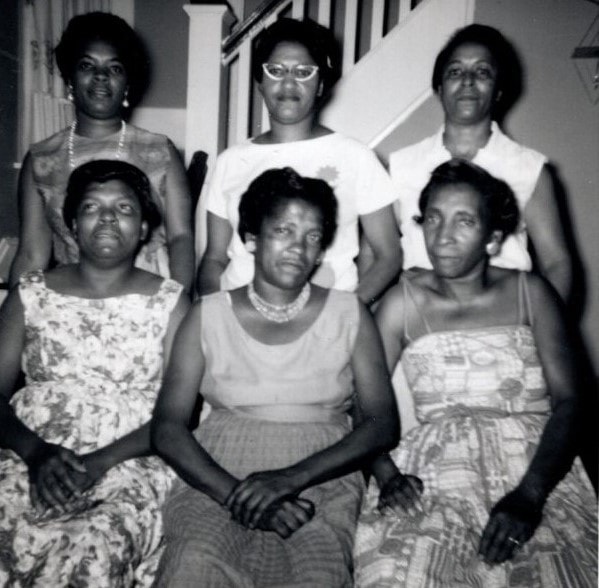
Six of Sallie’s eight children.
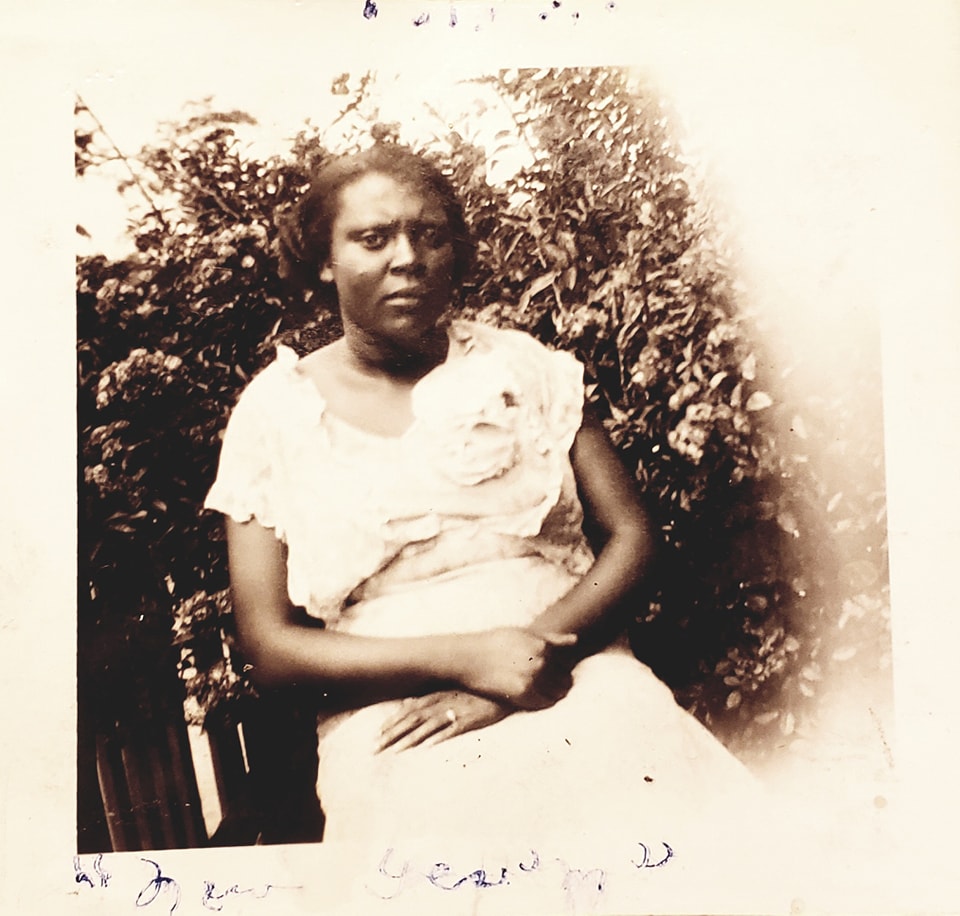
Her middle daughter, Mildred Francis.

Her only son, Charles.
Sallie was resourceful and family oriented. Her daughter, Pearl remembered that their mother designed their dresses and made their dolls.8 Her younger daughter described how her mother named them after family members and friends. Her oldest, a son is named after her Uncle Charles. A middle daughter, Mildred Francis after her Grandmother Millie, and herself. Her youngest daughter Anna Mae is her sister, Mae’s namesake.9 Her naming practices would later help me make a huge genealogy discovery.
Sallie’s Uncle Charles Clinton Method lived in my hometown.10 He left West Virginia around the death of his mother, Millie Davis Method in the mid-1870s.11 He married Keziah Foster Lowery in 1877, in Ross County, Ohio. 12 The couple raised their son, William Arthur Method, who became a physician and founded the first and only African American Hospital in Central Ohio in the 1920s.13
Click here to see the hospital and the physician on page 28. https://www.columbuslandmarks.org/wp-content/uploads/2019/02/African-American-Comm.pdf
Sallie spent her last day caring for her family. Her daughter described they were going in and out of the house hanging laundry.14 When she returned inside Sallie collapsed in the kitchen. The neighbors later arrived and found her surrounded by her daughters.15
Her former in-laws agreed to have her buried in their family plot in Oak Hill cemetery.
Sallie Francis Method Ford, 1884 -1938.
I hope you celebrated your mothers today and remember those women who are no longer here physically to nurture and love us through these earthly journeys.
Sources.
Great Aunt Jennie was the third daughter of my maternal Great-Great-grandparents, Samuel Grimsley and Nettie Smart. Her oldest sister was my Great-grandmother Sarah Lula Grimsley Ervin.
My Grimsley ancestors lived in Abbeville, Henry County, Alabama. Henry County’s border touches the Georgia’s state line.
Sarah, her husband, Jarrett Ervin, and their four children migrated to Columbus, Ohio, in the early 1920s.
Jennie and her husband, Carl Tiller were a childless couple. They migrated to Bayonne, New Jersey, in the early 1930s.
Annie Jennie nicknamed Zada called Sadie came to visit her sister in 1932.
My mom’s oldest sister, Aunt Ceil, told me this story about Jennie’s visit.
Jennie didn’t return home to her husband.
Sarah had been ill, near death. When Jennie saw her lying in bed, she prayed, “God allow me to take on her sickness so she can care for her many children.” Sarah had four children at the time of her sister’s visit; three sons and a daughter had previously passed. After her prayer, Jennie became ill. She laid down in Sarah’s bed. Sarah’s health improved, and she rose out of that bed. Jennie died. Family members said an image of a dove appeared and flew away when Jennie passed.
Just like that Aunt Jennie went onto glory.
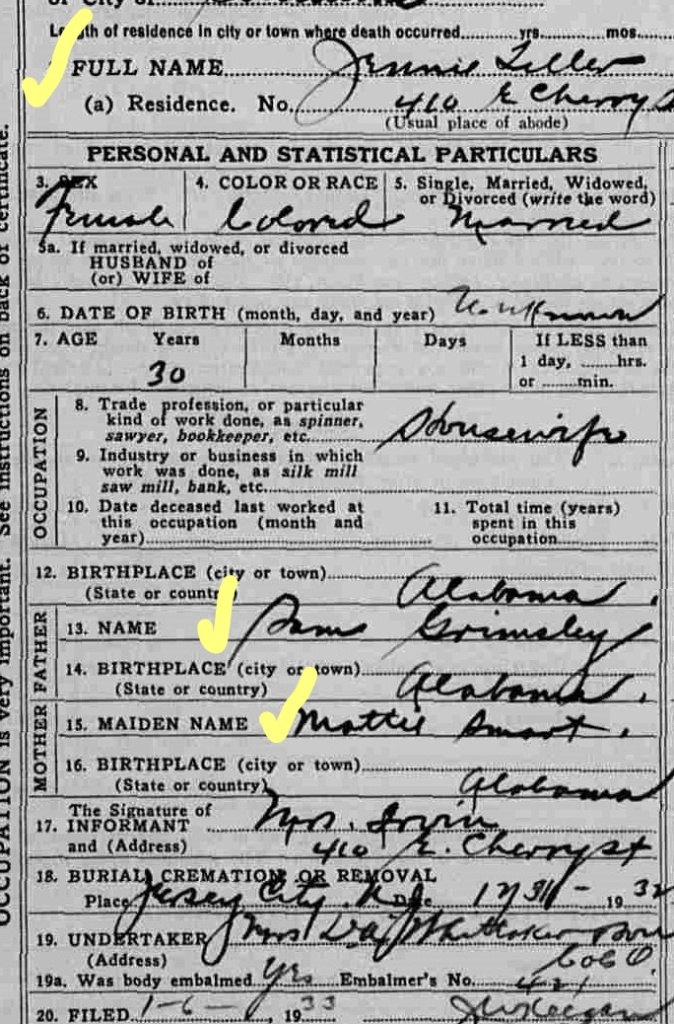
I never repeated that story, until I found some evidence that supports Aunt Ceil’s account about an aunt dying on a visit to Columbus.
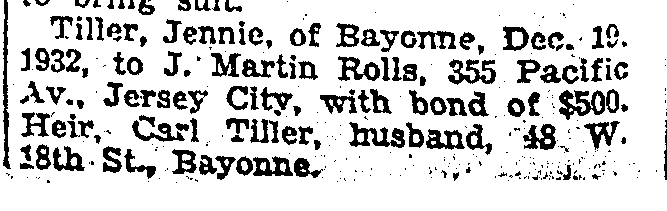
Jennie Tiller’s Ohio death certificate shows that she was not a Columbus resident. Jennie died from Bronchial Pneumonia, Influenza on December 19th, 1932. Mrs. Irvin, Sarah is the informant. I discovered a small blurb in the 1933 Jersey Journal Newspaper stating Carl Tiller was an heir to $500 from Jennie’s death.
The Flu is a contagious respiratory illness. It is still a dangerous illness to contract. According to the 1932 Mortality schedule, 129,540 people died to Influenza and pneumonia. Data for Columbus, Ohio, shows that over 200 African Americans died in 1932 from the illness. Jennie is in that number.

There is an expression that says; There is no greater love than a brother to lay down his life for another. In this story, Jennie had loved her sister; she died for Sarah to live.

The repositories and databases I accessed to support my Aunt’s account of our family history are listed below.
Familysearch an online census records database.
GenealogyBank, an online newspaper database.
Mortality Statistics 1932 U. S. DEPARTMENT OF COMMERCE, BUREAU OF THE CENSUS, THIRTY-THIRD ANNUAL REPORT page, 26.
UPDATE: On June 15th, 2021, A correction includes Sarah lost a daughter.

